Related Industries
Curation by industry experts
Hot Articles
Popular Tags
Can My Cooling Tower Handle an Added Liquid Cooling Load?
Can my existing cooling tower handle the added liquid cooling load? Possibly, but the answer depends on the heat the entire cooling system can reject under the conditions that matter most, not just the capacity printed on the tower nameplate. A tower that appears lightly loaded on a cool day may have little usable headroom during hot, humid weather or when one cooling cell is unavailable.
Start by comparing the proposed heat load with the plant’s available capacity at the required operating temperatures, water flows and redundancy level. Then trace the load through the complete cooling path: the liquid cooling equipment, heat exchangers, pumps, piping, controls and tower all have to work together.
How much heat will the new equipment add?
The starting point is the expected electrical power consumed by the IT equipment, expressed in kilowatts, together with the proposed cooling arrangement. Nearly all electrical power used by IT equipment ultimately becomes heat, but not all of that heat necessarily reaches the tower through the same path.
For example, a direct-to-chip system may carry processor heat away in liquid while fans, power supplies and other components continue to release heat into the room. That room heat may already reach the same tower through a chiller system, or it may be rejected elsewhere. Immersion systems have their own heat-transfer paths and ancillary loads. A facility heat balance should account for each path without counting the same heat twice.
Ask the equipment and cooling suppliers for the expected liquid-side heat load, residual air-side load, operating temperatures and flow requirements at the intended configuration. Include relevant auxiliary loads, such as pumps and any additional cooling equipment. Use coincident operating demand for the assessment: the highest possible rating of every device added together may not describe normal operation, but an average workload alone is not a safe basis for peak or failure conditions.
If the servers are replacing existing equipment, calculate the net change in heat rejected by the plant. If they are an expansion, the existing load remains part of the calculation. Also establish whether the stated power figure is IT power, rack input power or total facility demand; those boundaries are not interchangeable.
Why the tower nameplate is not enough
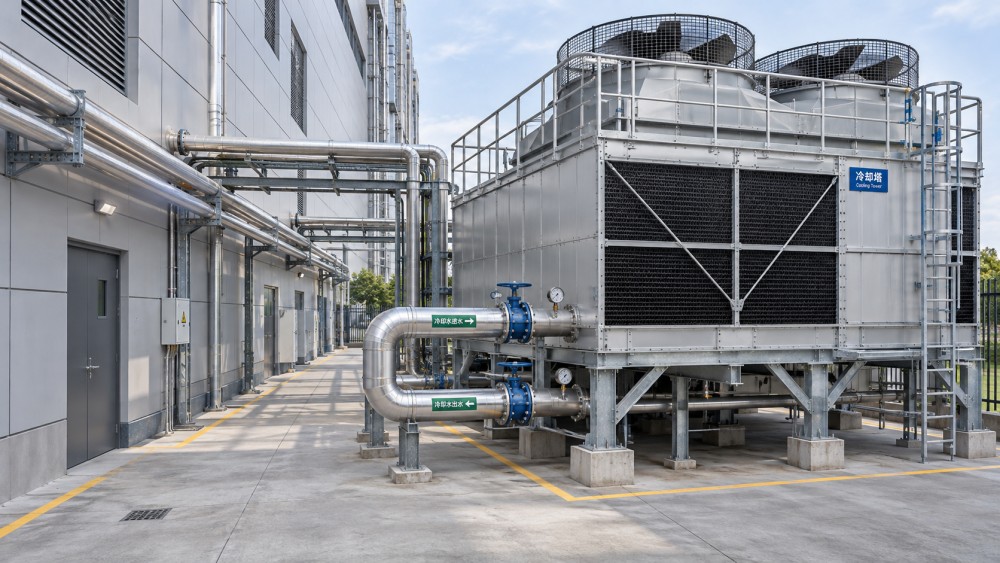
A cooling tower rating applies at specified entering and leaving water temperatures, water flow and outdoor wet-bulb temperature. Wet-bulb temperature reflects the combined effect of air temperature and humidity on evaporative cooling. As it rises, a tower generally has less ability to cool water to a given temperature.
The existing tower may therefore deliver a different amount of cooling at the conditions required by a new liquid cooling system. Its current condition matters too: fouled fill, blocked nozzles, reduced fan performance or uneven water distribution can reduce performance relative to the original rating.
Have the tower supplier or a qualified mechanical engineer evaluate the installed equipment at the proposed operating point. The useful comparison is not simply “tower capacity minus current load.” It is whether the plant can reject the combined heat while delivering water at the temperature and flow required by all connected equipment, including during the site’s design weather conditions.
Historical trends are valuable, particularly simultaneous readings of tower supply and return temperatures, flow, fan operation, wet-bulb temperature and plant load. They show how the system behaves in practice. However, a history that does not include demanding weather, peak load or an equipment outage cannot establish capacity for those conditions by itself.
Can the tower deliver water cool enough?
A tower may have sufficient overall heat-rejection capacity and still fail to meet the temperature required by the liquid cooling loop. The limiting factor can be the temperature difference needed across each heat exchanger.
In a common arrangement, tower water transfers heat through a facility-side heat exchanger to a separate loop. A coolant distribution unit, or CDU, may then use another heat exchanger to cool the technology-side liquid. Each exchanger needs an appropriate temperature difference to transfer heat. The temperatures available at the servers therefore depend on the whole chain, not solely on the tower outlet.
Warmer liquid supplied to the IT equipment can make tower-based heat rejection easier, but only when the servers, CDU and controls are designed to operate at those temperatures. Conversely, colder supply requirements may require a chiller or another cooling stage during some conditions. Check the permitted supply-temperature range and operating envelope for the actual equipment, including any limits that change with workload or coolant flow.
Temperature stability matters as well. Rapid changes in compute demand can affect return temperatures and control valves. A system that meets a steady-state calculation may still need control adjustments to avoid hunting, unstable supply temperatures or unnecessary switching between cooling modes.
Will the existing water system carry the extra load?
Heat rejection depends on water flow as well as temperature. The new branch may require more flow than existing pumps, pipes, valves, strainers or heat exchangers can provide. Even when a pump has spare motor capacity, pressure losses through a new connection can leave insufficient flow at a distant CDU or reduce flow to existing equipment.
Review the hydraulic path at the required operating points, including minimum and maximum flow, pump curves, control valve pressure drops and the impact on other branches. A higher temperature difference between supply and return can reduce the flow needed for a given heat load, but it must be compatible with the connected equipment and the plant’s control strategy.
Physical connection details can also become project constraints. Space for isolation valves, filtration, metering, maintenance access and leak management should be established before selecting a tie-in point. A spare pipe connection is not proof that the distribution system has spare capacity.
Does spare capacity remain during maintenance or a failure?
Evaluate capacity in the operating states required by the facility, not only with every tower cell, pump and heat exchanger available. If the site is designed to tolerate the loss of one component, calculate whether the remaining equipment can support the combined load under the relevant weather and operating conditions.
The answer may vary by component. A plant can have a redundant tower but a single shared heat exchanger, pump header or control device that limits service during maintenance. Similarly, a new CDU may be redundant internally while depending on a facility-water connection that is not.
Where full support during an outage is not feasible, determine the operational consequence in advance. Options may include limiting compute load, staggering maintenance, providing temporary cooling connections or adding equipment. Any planned load reduction needs an agreed method for detecting the condition and reducing demand quickly enough to protect the equipment.
Can tower water go directly to the liquid-cooled servers?
Usually, the tower-water circuit and the liquid in contact with IT equipment are kept separate through heat exchangers. An open cooling tower is exposed to air and can introduce particles and other contaminants. Its water chemistry and materials may not be suitable for small passages, cold plates or the components specified by the IT equipment supplier.
Separation does not eliminate water-quality work. Each loop needs treatment, filtration and monitoring appropriate to its materials and equipment requirements. Review compatibility across pipes, seals, heat exchangers, cold plates and any specified coolant additives. The design should also address leaks, isolation, draining, refill procedures and access for service.
Additional tower load can increase evaporation and change make-up water, blowdown and treatment needs. Check the capacity of the water supply, treatment system and drainage arrangements alongside the thermal assessment. A cooling solution that works thermally can still be difficult to operate if those supporting systems are constrained.
What information is needed for a practical assessment?
Before committing to equipment or a deployment date, assemble a shared set of inputs for the facility team, liquid cooling supplier and mechanical engineer:
- Proposed IT deployment: equipment configuration, expected and peak power, deployment phases, operating schedule and anticipated load changes.
- Cooling requirements: liquid and residual air-side heat loads, permissible supply temperatures, flow requirements, pressure limits and coolant specifications.
- Existing plant: tower selection data, current equipment condition, piping and instrumentation diagrams, pump curves, heat exchanger data and control sequences.
- Operating evidence: simultaneous temperature, flow, weather, fan and load trends, with enough context to identify which equipment was running.
- Reliability requirements: required maintenance and failure scenarios, acceptable load reductions and the equipment that must remain in service.
Use these inputs to develop a heat balance and hydraulic assessment for normal operation, demanding weather and relevant equipment-outage scenarios. The outcome should identify the limiting component, the available margin at the stated conditions and the changes needed before the new load is connected.
Commissioning should then demonstrate the integrated system: flow balancing, temperature control, alarms, isolation, failure responses and the transition between operating modes. Acceptance conditions should be agreed before installation, including how performance will be assessed if the required weather or full IT load is not present during testing.
What if the tower does not have enough capacity?
The appropriate upgrade depends on the constraint. Cleaning or repairing an underperforming tower may restore lost capacity, while pump or piping changes may solve a distribution bottleneck. A larger heat exchanger can help when its temperature difference or pressure drop is the limiting factor, but it cannot compensate for a tower that cannot reject the total heat.
If the heat-rejection plant itself is undersized, options include adding tower capacity, installing a separate heat-rejection system or using a supplementary chiller arrangement. Each changes the requirements for space, power, water, controls, maintenance and redundancy. A phased IT deployment or a controlled load limit can also bridge a capacity gap, provided the limit is enforceable and consistent with the facility’s availability commitments.
The most useful next step is to establish the limiting condition before choosing an upgrade. A documented operating-point assessment turns an apparent spare-capacity figure into a decision about what the facility can actually support.
Questions about data center smoke detection standards? Contact RackLedger for further insights.
We respect your privacy. Your information is strictly confidential.
Recommended News
 Data Center Variable Frequency Drives: Cutting Fan and Pump Energy UseData Center Variable Frequency Drives can cut fan and pump energy use. Explore retrofit opportunities, costs, risks, and practical steps to protect cooling reliability.Nov 04, 2026
 Why Is My Coolant Temperature Sensor Reading Too High?How do I troubleshoot a coolant temperature sensor that reads too high? Verify the reading, trace cooling and control faults, and protect data center equipment.Nov 04, 2026
 Where Should Coolant Temperature Sensors Be Placed in a Loop?Where should coolant temperature sensors be placed in a liquid cooling loop? Explore CDU supply, return and rack-level locations for reliable monitoring.Nov 04, 2026
 How Do I Size a Coolant Reservoir for a Liquid Cooling Retrofit?How do I size a coolant reservoir for a liquid cooling retrofit? Learn how to calculate usable capacity, check pressure and avoid costly sizing mistakes.Nov 04, 2026