Related Industries
Curation by industry experts
Hot Articles
Popular Tags
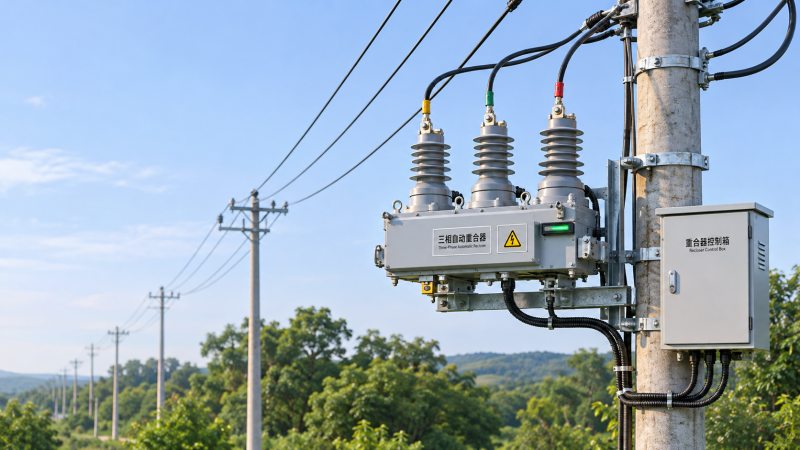
How Automatic Reclosers Restore Power After Transient Line Faults
Automatic reclosers restore power after some temporary line faults by interrupting the fault current, waiting for the disturbance to clear, and then closing the circuit again. If the fault has disappeared, electricity can resume without a crew manually operating the device. If it remains, the recloser can trip again and, after its configured attempts, lock out with the circuit open.
This distinction matters for understanding utility reliability. A successful reclose can turn what might otherwise be a sustained outage into a brief interruption, but it does not prevent every voltage disturbance or guarantee that connected equipment remains online. The result depends on the fault, the protection settings, and the electrical equipment downstream.
Why opening and closing a line can restore power
An overhead distribution line is exposed to conditions that can briefly create an unintended path for current. A tree branch may touch a conductor and fall away, or lightning may initiate a flashover across insulation. In these cases, the fault may no longer exist once the protective device interrupts the current and the electrical arc has had time to die out.
A permanent fault is different. A broken conductor, damaged insulator, or branch lodged against a line can remain in place after the circuit opens. Re-energizing the line does not remove the physical cause. The renewed fault current prompts another protective operation, and the device eventually stops trying if the fault persists.
The distinction is not always visible from the initial electrical measurement. A recloser detects conditions consistent with a fault; it cannot necessarily tell at the moment of detection whether the cause will disappear. Its operating sequence gives a temporary fault an opportunity to clear while limiting repeated exposure to a fault that remains.
What happens during a reclosing sequence
A recloser combines a switching mechanism with a control system that monitors electrical quantities, including current. When the measured current and timing satisfy the configured protection criteria, the control sends a trip command. The interrupter opens the circuit and stops current flowing through the fault.
After a programmed open interval, often called the dead time, the control commands the device to close. The line is energized again. If current returns to an acceptable condition, service remains on and the sequence can reset after a configured period. If fault current returns, the device trips again. Depending on its settings, it may make another closing attempt before entering lockout.
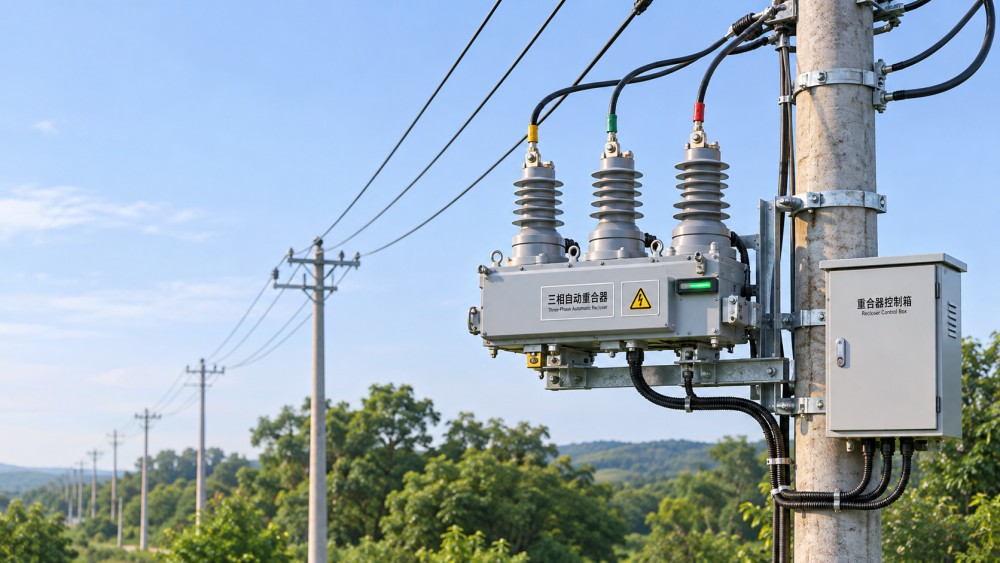
A simplified sequence illustrates the logic:
- A temporary fault produces current that meets the protection settings.
- The recloser trips and interrupts the circuit.
- During the open interval, the arc extinguishes and the temporary cause clears.
- The recloser closes, and normal current resumes.
The successful outcome depends on the cause actually clearing before the circuit is re-energized. Opening the circuit can extinguish an arc, but it cannot be relied on to remove a physical obstruction. Closing too soon can also result in another fault if the path has not recovered sufficiently.
The number of attempts, the intervals between them, and the trip characteristics are settings rather than universal features of every installation. Some controls permit different protection behavior on successive operations. The chosen sequence reflects the network design and coordination with other devices, not simply a desire to restore service as quickly as possible.
What the recloser measures—and what it cannot know
The basic protection decision is electrical. Fault current may rise substantially above normal load current, and protection settings define how the device responds to a given current over time. Depending on the control and scheme, separate functions can address faults between phases and faults involving ground.
High current alone does not describe every abnormal condition perfectly. Normal operating events, including equipment energization or changes in load, can also produce elevated current. Settings must therefore distinguish the conditions the device is intended to interrupt from acceptable operating behavior, within the limits of the available measurements and protection scheme.
Fault current also varies with location and network conditions. A fault farther from a source can produce less current than a nearby fault because of the impedance between the source and the fault. A protection setting that responds properly to one condition may need careful review against other credible operating configurations.
The recloser does not directly verify that a fallen branch has moved or that damaged insulation has been repaired. It tests the circuit electrically by closing it. If the fault remains and the protection detects it again, another trip follows. If a fault is not detected under a particular operating condition, the expected sequence cannot be assumed.
Why dead time and trip timing matter
The open interval serves a practical purpose: it allows time for a temporary arc to extinguish and for the fault path to recover. The appropriate interval depends on the system and application. A shorter interval can restore supply sooner when the fault clears quickly, while a longer one may give a transient disturbance more time to disappear.
That trade-off affects connected loads. Even a successful reclose involves an interruption downstream of the open device. Equipment may see a voltage dip during the fault, loss of voltage while the circuit is open, and another disturbance when power returns. Motors, electronic power supplies, and control systems do not all respond in the same way.
Trip timing matters as well. Protection is designed to remove faults promptly, but devices along a feeder must also be coordinated. An upstream device that trips too readily can interrupt a larger section of the network than necessary. One that operates too slowly can leave fault current flowing longer than intended. The settings are therefore part of a system-level protection design.
Lockout: when automatic restoration stops
Lockout is the state in which the recloser remains open after its configured sequence, or as otherwise dictated by the protection scheme. It prevents the device from repeatedly energizing a circuit under conditions where continued attempts are not appropriate.
For a persistent fault, lockout generally means the affected section requires investigation and correction before normal service is restored. Restoration may involve locating damage, isolating a faulted section, making repairs, or reconfiguring the network. The exact process depends on the utility’s equipment and operating procedures.
Lockout does not identify the cause by itself. A recloser may provide event records and electrical measurements that help narrow the investigation, but an open device is evidence of a protection operation, not proof of a particular failed component. Equally, a successful reclose does not prove that the line is free of underlying defects; it only shows that the circuit was able to remain energized under the conditions following that operation.
How reclosers coordinate with fuses and other protection
A recloser is rarely the only protective device on a distribution network. A feeder may include an upstream circuit breaker, additional reclosers, and fuses protecting individual branches or equipment. Their settings and operating characteristics determine which device clears a fault and how much of the network loses power.
For example, a fault on a fused lateral may be temporary. In a fuse-saving approach, an upstream recloser can be set to trip quickly enough to clear certain temporary faults before the lateral fuse melts. If the fault remains through subsequent operations, the coordination scheme may allow the fuse to isolate the lateral. The main feeder can then remain energized after the faulted branch is separated.
A different approach, often called fuse-blowing, allows the lateral fuse to operate for applicable faults before the upstream recloser trips. This can spare customers on the main feeder from an interruption caused by a lateral fault, but customers beyond the operated fuse may experience a sustained outage even when the original fault was temporary.
Neither approach is universally preferable. The result depends on fault current, device characteristics, settings, and network configuration. Coordination can also be more complicated where generation or other sources contribute fault current from different directions. A diagram showing a recloser and a fuse is not enough to establish which one will operate first.
Where an interruption is felt
A recloser can only interrupt current through the section it controls. Customers downstream of an opened device can lose supply during the open interval; customers upstream may avoid a complete interruption but can still experience a voltage disturbance while the fault exists. The precise effect depends on the network and fault location.
Placement therefore changes the reach of an operation. A device nearer the source may protect a larger part of a feeder, while a device farther along the line can isolate a smaller downstream section. More sectionalizing can reduce the area affected by some faults, but each protective device must be coordinated with the rest of the network.
Reclosing also needs to be considered alongside operating restrictions. Utilities may disable or modify automatic reclosing under specified conditions, including certain maintenance activities or heightened wildfire-risk operations. When reclosing is disabled, a fault that might otherwise have cleared through an automatic sequence can instead lead to an interruption requiring operational intervention. The applicable practice depends on the utility and its safety rules.
What a successful reclose means for critical facilities
Restored utility voltage is not the same as uninterrupted power at the load. A data center connected downstream may experience the initial fault as a voltage sag, followed by an interruption during the open interval. If the recloser closes onto a persistent fault, the facility may see another disturbance before lockout.
An uninterruptible power supply can bridge an incoming supply disturbance if it is appropriately designed, available, and operating within its limits. Backup generators may support a longer loss of utility supply, subject to starting, transfer, fuel, and maintenance arrangements. These systems address a different part of the reliability problem: the recloser attempts to restore the utility circuit, while facility power systems are intended to support selected loads when the incoming supply is outside acceptable conditions.
The interaction can be operationally significant. Utility voltage may return before a generator has started, during a transfer sequence, or after the facility has stabilized on backup power. Whether and when the facility returns to utility supply depends on its transfer controls and settings. A brief utility interruption should not be assumed to produce a brief event in every part of the facility.
Event records are more informative when read together. A recloser operation record can show trip and close times or measured fault quantities; facility monitoring can show incoming voltage, UPS status, generator behavior, and transfer events. Matching timestamps and measurement locations helps distinguish the original fault, the open interval, and the response of on-site equipment.
The essential point is that automatic reclosing is a controlled retry, not a repair. It is effective when the fault clears within the protection sequence and the circuit can safely remain energized. When the cause persists, coordinated tripping and lockout limit further attempts and leave restoration to isolation, repair, or network reconfiguration.
Questions about data center smoke detection standards? Contact RackLedger for further insights.
We respect your privacy. Your information is strictly confidential.
Recommended News
 How Automatic Reclosers Restore Power After Transient Line FaultsAutomatic Reclosers restore power after temporary line faults. Discover how reclosing sequences, protection settings, and lockout support grid reliability.Nov 04, 2026
 Why Transformer Cooling Fans Fail and How to Diagnose Common FaultsTransformer Cooling Fans not working as expected? Learn how to diagnose common faults, check airflow and controls, and restore reliable cooling safely.Nov 04, 2026
 What Is Transformer Oil? Insulation and Cooling Functions ExplainedTransformer oil supports electrical insulation and cooling. Discover how it works, how it is tested, and why its condition matters for power reliability.Nov 04, 2026
 Sodium-Ion UPS Batteries vs. Lithium-Ion: What Buyers Should CompareSodium-Ion UPS Batteries vs. lithium-ion: compare runtime, safety, compatibility and lifecycle costs to make a confident data center buying decision.Nov 04, 2026