Related Industries
Curation by industry experts
Hot Articles
Popular Tags
Propylene Glycol in Cooling Loops: Concentration and Freeze Protection
Propylene glycol concentration should be high enough to protect the coldest vulnerable part of a cooling loop, while remaining low enough to meet equipment, fluid chemistry, and hydraulic requirements. For a data center facility loop exposed to freezing weather, that decision starts with the lowest credible fluid temperature during normal operation, shutdown, and loss of flow. It does not start with a standard percentage.
The target also depends on what “protection” means. Preventing the first ice crystals from forming is a different objective from limiting damage to piping after some freezing has occurred. A concentration selected for one may not satisfy the other, and neither automatically guarantees that pumps, heat exchangers, or control valves will operate properly at the lowest temperature.
Freeze Point and Burst Protection Are Different Design Targets
As a propylene glycol solution cools, ice formation can begin at its freeze point. The remaining liquid then becomes more concentrated in glycol, and the mixture can develop into a slush rather than immediately becoming a solid mass. Depending on the fluid, temperature, and equipment geometry, that slush may restrict flow or prevent a pump from starting even when the system has not suffered a pipe rupture.
Burst protection describes a lower-temperature objective associated with reducing the risk of physical damage from freezing and expansion. It should not be treated as a promise that every component will survive an extended cold exposure. Heat exchangers, small passages, valves, instruments, and trapped sections can be more vulnerable than the pipework used as the basis for a supplier’s burst-protection guidance.
For a loop that must circulate or start reliably in cold conditions, select a concentration against the required freeze point and low-temperature operating properties, not just a burst-protection rating. For a loop that can be shut down during an extreme event, burst protection may be part of the assessment, but the owner still needs an approved restart procedure and a component-by-component review of the consequences of slush formation.
Fluid suppliers publish concentration curves, but the evaluator must check what each curve represents. A table may report the onset of crystallization, a particular degree of slush formation, or a burst-protection limit. These values are not interchangeable. Use the data for the specified product and establish whether concentration is stated by volume or by weight.
Start With the Coldest Exposure, Not the Average Loop Temperature
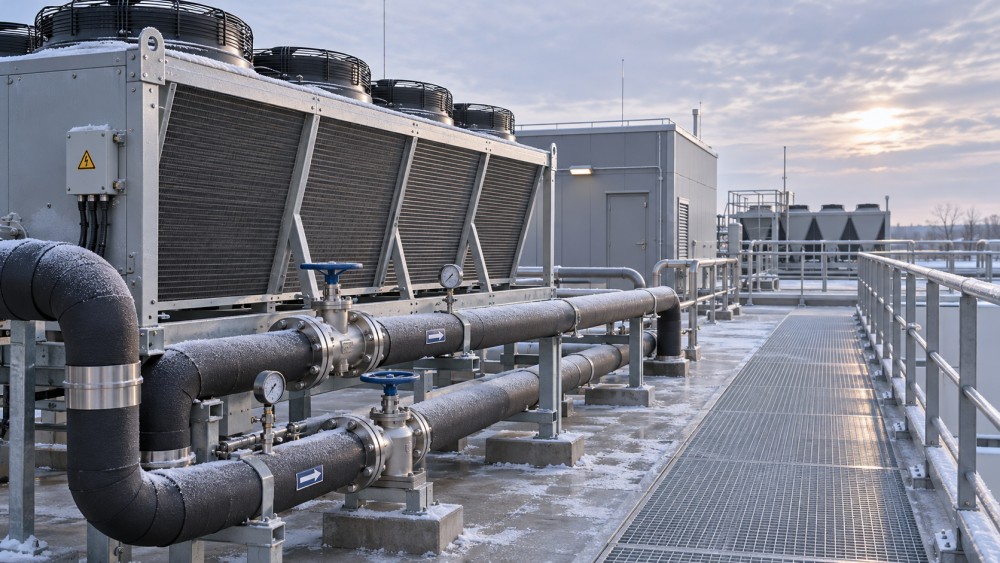
A cooling loop can operate at a comfortable supply temperature and still contain a section exposed to freezing. Outdoor dry coolers, roof-level piping, air-cooled equipment, inactive branches, and sections near building openings deserve particular attention. A sensor at the central plant may not register the lowest temperature in a stagnant or poorly insulated portion of the circuit.
The design temperature should reflect credible operating and failure conditions, including loss of power, pump shutdown, control failure, and an extended maintenance outage. Outdoor air temperature is an input, not automatically the fluid temperature: exposure duration, wind, insulation, heat tracing, equipment thermal mass, and residual heat all affect how quickly a particular section cools.
Heat tracing and insulation can reduce exposure, but their contribution should be assessed under the same failure conditions used to set the protection target. If tracing relies on a power source that may be lost during the event being considered, it should not be treated as an unconditional safeguard. Similarly, a drain-down strategy needs a practical way to remove liquid from low points, coils, valves, and equipment internals.
Once the lowest credible fluid temperature is established, the engineering team can select a margin appropriate to the uncertainties in exposure, measurement, mixing, and operation. The fluid supplier’s curve then identifies a candidate concentration. Equipment limits and hydraulic calculations determine whether that candidate is workable.
Why More Glycol Can Create a Different Cooling Problem
Adding propylene glycol changes fluid properties throughout the operating range. Compared with water, a glycol solution generally has lower heat capacity and higher viscosity; its density and thermal conductivity also change. At low temperatures, the increase in viscosity can be particularly important.
For a specified heat load and temperature rise, lower heat capacity can require a higher flow rate. Higher viscosity can increase pressure loss and alter heat-transfer behavior, particularly in narrow passages. Together, these effects can reduce available flow or increase pump power. The impact depends on concentration, fluid temperature, pipework, pump characteristics, and heat exchanger design; it cannot be established from a freeze-point table alone.
The evaluation should therefore cover at least two distinct conditions: the coldest credible start or operating condition, and the conditions at which the loop must remove its design heat load. A pump may be acceptable at normal temperature but unable to deliver the required flow with cold, viscous fluid. Conversely, a mixture that provides ample cold-weather protection may leave insufficient heat exchanger capacity at the intended operating temperatures.
Review the following against the selected product’s property data:
- Pump duty: Required flow and differential pressure across the temperature range, including cold start and the effect of viscosity on pump performance.
- Heat exchanger capacity: Performance with the actual fluid, concentration, flow rates, and entering temperatures on both sides.
- Pressure losses: Piping, strainers, control valves, coils, and distribution equipment at the relevant temperatures and flow rates.
- Equipment limits: Permitted glycol type and concentration, minimum operating temperature, and any manufacturer-specific derating or fluid requirements.
This is especially consequential where an existing water system is being converted to glycol. The original pump and heat exchanger selections may have little spare capacity. Increasing pump speed is not automatically sufficient: the revised duty must remain within motor, pump, pressure, noise, and equipment limits.
Facility Loop Concentration Does Not Define the IT Coolant
In a data center, the glycol-protected circuit may be separated from the IT equipment circuit by a heat exchanger in a coolant distribution unit. The facility side and the technology side can have different exposure conditions, fluid specifications, temperatures, and maintenance requirements.
Do not assume that a concentration suitable for an outdoor heat-rejection loop is acceptable in cold plates, manifolds, pumps, seals, or a server manufacturer’s coolant circuit. The equipment provider may specify a different fluid chemistry or prohibit a particular additive package. Even where glycol is permitted, the allowable concentration and water-quality requirements can differ between connected systems.
That separation also affects performance calculations. A glycol mixture on the facility side can change the heat exchanger’s capacity and the temperature approach required to transfer a given load. The IT-side supply temperature should be assessed with the actual facility fluid and expected conditions, including degraded operating states, rather than with a water-only rating.
Concentration Is Only One Part of the Fluid Specification
A measured glycol percentage says little about the condition of the inhibitor package or the cleanliness of the loop. Commercial heat-transfer fluids are formulated with corrosion inhibitors, and their suitability depends on the materials and operating conditions for which they were designed. Uninhibited glycol, an incompatible additive package, or inappropriate make-up water can create problems even when freeze protection is adequate.
Check the fluid specification against wetted metals, elastomers, seals, plastics, coatings, brazed joints, and any treatment chemicals already present. Water used for dilution or top-up should meet the fluid and equipment suppliers’ requirements. Hardness, dissolved solids, and other water characteristics can affect deposits, corrosion, and inhibitor performance.
Mixing different glycol products or treatment chemistries should not be assumed acceptable simply because both contain propylene glycol. Obtain compatibility guidance before combining them. Where the existing fluid is unidentified or its condition is poor, sampling and an engineered cleaning and replacement plan may be needed before a new formulation is introduced.
Concentration measurement also needs context. A refractometer can be useful for field checks, but it must be appropriate for propylene glycol, calibrated and used in line with its instructions. Contamination or other dissolved substances can affect readings. A concentration reading does not replace laboratory assessment of inhibitors, pH, contamination, and other parameters specified in the maintenance program.
Commission the Mixture and Keep It Within Its Operating Range
The selected concentration is a range to maintain, not a value that remains fixed after filling. Incomplete mixing can leave different sections of a system at different strengths. Water used for leak testing, flushing, or later top-up can dilute the mixture; repairs and partial replacements can change it again.
Commissioning should establish the final fluid identity, concentration basis, sampling locations, and acceptance limits. Circulate the mixture sufficiently for representative sampling where the system design permits, then check the result against both the minimum freeze-protection requirement and the maximum concentration allowed by the hydraulic design and equipment specifications.
Document the approved fluid, dilution water, test method, and top-up procedure for operations staff. Subsequent samples should be taken at intervals suited to the fluid supplier’s guidance and the system’s operating conditions, with additional checks after significant fluid loss, make-up, or maintenance. Results need to be interpreted alongside fluid chemistry and equipment condition, not as a freeze-point reading in isolation.
A sound selection is the lowest concentration that meets the specified protection target with an appropriate margin and remains within the fluid supplier’s and equipment manufacturers’ permitted range. If no concentration satisfies both the cold-weather requirement and the cooling equipment limits, the design needs another measure, such as separating an exposed circuit, changing equipment capacity, or providing a dependable means of preventing freezing.
Questions about data center smoke detection standards? Contact RackLedger for further insights.
We respect your privacy. Your information is strictly confidential.
Recommended News
 Data Center Variable Frequency Drives: Cutting Fan and Pump Energy UseData Center Variable Frequency Drives can cut fan and pump energy use. Explore retrofit opportunities, costs, risks, and practical steps to protect cooling reliability.Nov 04, 2026
 Why Is My Coolant Temperature Sensor Reading Too High?How do I troubleshoot a coolant temperature sensor that reads too high? Verify the reading, trace cooling and control faults, and protect data center equipment.Nov 04, 2026
 Where Should Coolant Temperature Sensors Be Placed in a Loop?Where should coolant temperature sensors be placed in a liquid cooling loop? Explore CDU supply, return and rack-level locations for reliable monitoring.Nov 04, 2026
 How Do I Size a Coolant Reservoir for a Liquid Cooling Retrofit?How do I size a coolant reservoir for a liquid cooling retrofit? Learn how to calculate usable capacity, check pressure and avoid costly sizing mistakes.Nov 04, 2026