Related Industries
Curation by industry experts
Hot Articles
Popular Tags
Cooling Towers in Data Centers: Open-Loop vs. Closed-Loop Systems
An open-loop cooling tower is often the simpler heat-rejection choice when a site can manage water treatment, equipment exposure, and routine cleaning. A closed-loop system is worth examining when protecting a process-fluid circuit from airborne contamination is important, but it can cost more, add heat-transfer temperature penalties, and still consume water if it uses evaporative cooling.
The choice becomes consequential when a data center expansion must fit an existing cooling plant, a restricted water allocation, or a fixed commissioning window. Selecting on equipment price alone can leave the project with insufficient temperature margin, unexpected treatment requirements, or a difficult outage during connection to the operating facility.
Start with the circuit, not the tower label
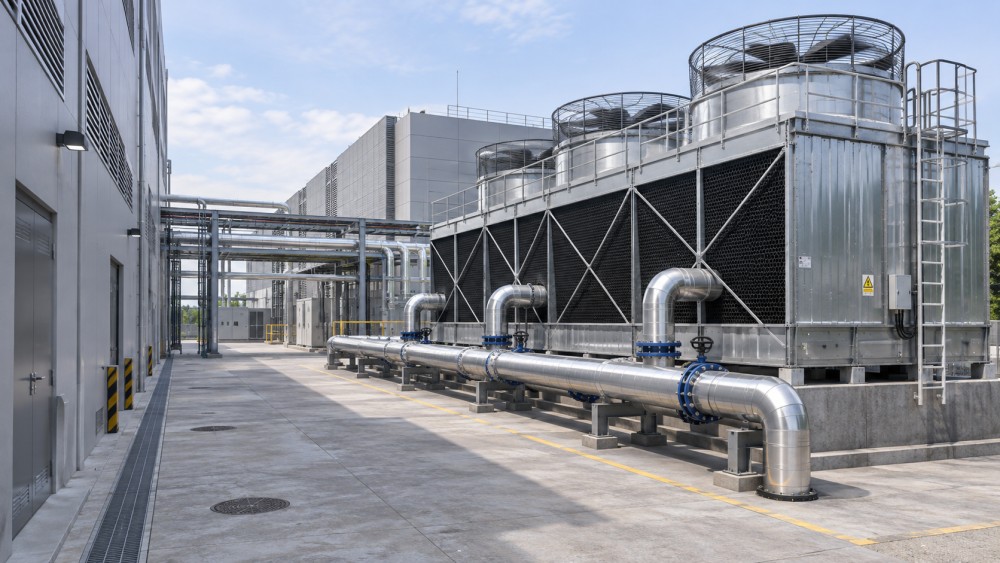
In an open-loop tower system, water flows through the tower and contacts air directly. A portion evaporates, rejecting heat; the remaining water collects in a basin and returns to the equipment being cooled. Depending on the plant design, that equipment might be a chiller condenser or an intermediate heat exchanger. The recirculating water is exposed to airborne debris and requires treatment, filtration where appropriate, and periodic discharge of concentrated water, known as blowdown.
In a closed-circuit cooling tower, the process fluid flows inside a coil and does not directly contact the outside air or spray water. In an evaporative closed-circuit unit, water is sprayed over the coil while air passes across it. The enclosed process circuit is protected from direct exposure, but the external spray system still needs water management. Dry coolers also use a closed fluid circuit, but reject heat without evaporation during dry operation; they should not be assumed to have the same temperature capability as an evaporative tower.
These terms can describe different parts of a plant. An open tower may serve a heat exchanger that separates tower water from a closed facility loop. Likewise, a closed-circuit tower does not automatically connect directly to servers. Ask for a complete flow diagram identifying every fluid, heat exchanger, pump, and temperature boundary before comparing bids.
Test the required temperatures before comparing costs
Begin with the heat load at the intended operating condition, not just the IT nameplate rating. The heat-rejection plant may also handle losses from power equipment and other facility loads. Establish normal and peak conditions, the initial phase, planned expansion, and the capacity required when a component is unavailable. Record whether the stated load is an IT load or the total heat presented to the tower system.
Next, trace temperatures from the heat-producing equipment to the outdoor unit. For a liquid-cooled deployment, this may include the server cooling loop, a coolant distribution unit heat exchanger, the facility-water loop, and possibly another exchanger between that loop and tower water. Each heat-transfer step needs a temperature difference. Pumps, valves, piping, and controls also affect whether the required flow reaches the equipment.
Evaporative tower performance depends strongly on entering-air wet-bulb temperature, as well as load and water temperatures. A closed-circuit coil or an added plate heat exchanger introduces another temperature difference that must be accommodated. An arrangement that works at part load or in mild weather may not deliver the required supply temperature at the site’s design condition. Request supplier selections at the same stated wet-bulb temperature, fluid flow, inlet and outlet temperatures, fouling assumptions, and required capacity.
For a dry cooler, compare against the applicable outdoor dry-bulb condition instead. Dry heat rejection can reduce or avoid evaporative water use, but its achievable fluid temperature is constrained by ambient air temperature and the selected equipment. Hybrid arrangements may use water only during some conditions; their annual water and energy use depend on the actual control strategy and climate.
Water availability is an operating constraint
An open tower continuously concentrates dissolved minerals as water evaporates. Makeup replaces evaporation, blowdown, drift, and other losses. Treatment settings and permitted water quality affect how much blowdown is required; they cannot be inferred from the cooling load alone. Poor control can lead to scale, corrosion, biological growth, or fouling that reduces heat transfer and increases maintenance.
A closed-circuit evaporative tower reduces direct exposure of the process fluid, but it does not eliminate spray-water evaporation, blowdown, or biological risks. The enclosed circuit also needs a specified fluid, compatible materials, appropriate treatment, and a plan for leaks or fluid replacement. Glycol may be needed for freeze protection in some designs, but its concentration changes heat-transfer and pumping requirements. Use the actual design fluid when requesting performance data.
Before choosing either configuration, establish the available makeup-water quality and quantity, discharge route, expected treatment approach, and applicable local requirements. Include seasonal restrictions and credible interruptions in the project risk register. Where reclaimed water is proposed, confirm material compatibility, treatment limits, and supplier acceptance rather than assuming it is interchangeable with potable water.
Water safety belongs in the operating design. Stagnant sections, aerosol generation, basin access, monitoring, cleaning, and disinfection procedures should be assessed under the site’s water-management program and applicable local rules. A closed process coil does not remove the need to manage the external evaporative system.
Compare complete plant arrangements
An open tower can be attractive where the site already has treatment capability, experienced operators, and compatible condenser-water equipment. If a clean facility loop is needed, an intermediate heat exchanger can create that separation. The added exchanger, pumps or pumping head, controls, piping, and maintenance access must be included in the comparison; the tower price is only one part of the installed system.
A closed-circuit tower may simplify the boundary between outdoor heat rejection and a protected fluid loop. It can be useful where exposure of process fluid would complicate downstream maintenance or compatibility. Its coil, however, can add pressure drop and thermal resistance, and exterior coil surfaces can scale or foul. Check whether the proposed unit can be inspected and cleaned without unacceptable disruption and what replacement would involve.
Neither option is universally more energy efficient. Fan power, pumping power, exchanger pressure drop, control settings, and the temperatures required by the rest of the plant all matter. A lower tower leaving-water temperature may reduce chiller work in one configuration, while additional pumps or an exchanger can offset part of that benefit. Compare annual operating estimates using the same weather data, load profile, equipment availability assumptions, and electrical boundary.
Resolve integration and construction risks early
Existing facilities often impose the hardest constraints. A proposed tower location may satisfy equipment footprint requirements but lack clearance for coil removal, basin cleaning, safe lifting, or unobstructed airflow. Recirculation of warm, moist exhaust into the intake can reduce performance; nearby walls, adjacent units, prevailing winds, and future construction should be included in the layout review. Structural capacity, vibration, noise, drainage, plume effects, and access for maintenance also affect placement.
For an operating plant, map the tie-in sequence before fixing the delivery schedule. Identify isolation points, temporary cooling needs, flushing boundaries, pressure testing, controls integration, and the permissible outage window. Adding a heat exchanger or changing the hydraulic circuit may require pump changes and control retuning beyond the tower package. Confirm equipment lead times and installation dependencies with suppliers rather than treating a delivery date as a commissioning date.
Redundancy must be checked at the system level. Spare tower capacity is of limited value if a shared pump, header, water supply, power feed, or control device can disable all heat rejection. Define the required operating state during maintenance and equipment failure, including whether the remaining plant can support the intended IT load at design weather conditions.
Make supplier responses comparable
Issue the same operating envelope and scope boundaries to each bidder. Require a schematic showing the proposed circuits and a schedule of temperatures, flows, pressure drops, fan and pump power, water quality limits, and performance at design and reduced load. Ask which equipment is included, which instruments and controls are supplied, and what site work remains with other contractors.
The evaluation should also cover treatment chemicals and monitoring, cleaning frequency assumptions, replacement parts, service access, and the availability of support. For an open-tower option with a separation exchanger, include the exchanger and its associated equipment in both capital and operating estimates. For a closed-circuit evaporative option, include the spray system and its water treatment rather than treating the unit as water-free.
Before acceptance, agree on measurable tests: flow and pressure checks, sensor verification, control sequences, alarms, and demonstration of the specified duty under conditions that can be achieved during commissioning. If design weather or full IT load is unavailable, document an agreed alternative test or performance verification method and any remaining limitations. Handover should include fluid specifications, treatment responsibilities, operating setpoints, maintenance procedures, and the response to loss of water, power, or communications.
The resulting decision may be an open tower with a separate clean loop, a closed-circuit evaporative unit, or a dry or hybrid arrangement where the temperature requirements permit it. The defensible choice is the one whose complete circuit meets the required duty and outage conditions while fitting the site’s water, maintenance, and construction constraints.
Questions about data center smoke detection standards? Contact RackLedger for further insights.
We respect your privacy. Your information is strictly confidential.
Recommended News
 Data Center Variable Frequency Drives: Cutting Fan and Pump Energy UseData Center Variable Frequency Drives can cut fan and pump energy use. Explore retrofit opportunities, costs, risks, and practical steps to protect cooling reliability.Nov 04, 2026
 Why Is My Coolant Temperature Sensor Reading Too High?How do I troubleshoot a coolant temperature sensor that reads too high? Verify the reading, trace cooling and control faults, and protect data center equipment.Nov 04, 2026
 Where Should Coolant Temperature Sensors Be Placed in a Loop?Where should coolant temperature sensors be placed in a liquid cooling loop? Explore CDU supply, return and rack-level locations for reliable monitoring.Nov 04, 2026
 How Do I Size a Coolant Reservoir for a Liquid Cooling Retrofit?How do I size a coolant reservoir for a liquid cooling retrofit? Learn how to calculate usable capacity, check pressure and avoid costly sizing mistakes.Nov 04, 2026