Related Industries
Curation by industry experts
Hot Articles
Popular Tags
Choosing Server Rack Shelves: Load Capacity, Depth and Mounting
Choosing Server Rack Shelves involves more than finding a shelf that fits a cabinet. For procurement teams, load capacity, usable depth, and mounting compatibility all affect equipment safety, installation time, and long-term serviceability. A shelf’s rated capacity may depend on how it is mounted and how weight is distributed, so specifications should be checked against the intended equipment and rack configuration. This guide outlines the key criteria to include in supplier comparisons and quotation requests.
Start with the equipment, not the shelf
A shelf may need to support a network appliance without rack ears, a tower server, test equipment, a monitor or a small uninterruptible power supply. These devices place different demands on the support surface. A compact appliance with its weight spread across four feet is not equivalent to a deep unit with a heavy battery concentrated near the front.
Before requesting prices, record the equipment’s operating weight, dimensions, foot positions and ventilation requirements. Include accessories that will sit on the shelf, such as external power supplies. If the device may be replaced during the shelf’s service life, identify the largest credible replacement rather than assuming today’s dimensions will remain adequate.
Also check whether the equipment manufacturer permits shelf mounting. Some devices are designed for dedicated rails or require specific support and clearance. A shelf that physically holds the unit does not automatically satisfy those instructions.
Load capacity: ask what the rating actually covers
The headline load rating is a useful starting point, but it is not a complete purchase specification. A supplier may state capacity for a uniformly distributed static load, with the shelf installed using a particular set of brackets and fasteners. That figure should not be treated as an unconditional limit for a concentrated load or a different mounting arrangement.
Ask suppliers to clarify the permitted load distribution, mounting configuration and any restrictions on overhang. Where a device has small feet, narrow rails or an offset center of gravity, provide a drawing or photograph and request written confirmation that the support arrangement is suitable. If the supplier cannot substantiate the rating for the proposed use, compare a different shelf or ask an engineer to assess the arrangement.
Leave capacity for foreseeable changes, but do not substitute an arbitrary safety margin for the supplier’s conditions. The rack itself, its mounting rails, anchoring and floor also have limits. Adding several individually acceptable shelves can still create an unacceptable total cabinet load or an unfavorable weight distribution. Heavier equipment is generally easier to manage lower in the rack, subject to the rack manufacturer’s instructions and site requirements.
Static load is not the whole handling scenario
A device may be safe when resting on a fixed shelf but create additional forces while being installed, moved or serviced. Sliding shelves need particular attention: the relevant capacity may differ between the closed and extended positions, and extension can affect rack stability. Confirm the allowable load in each position, any locking provisions and whether the cabinet requires stabilizers or anchoring before extension.
For heavy equipment, agree on the installation method as well as the shelf rating. A lifting aid, clear access route or additional technician may affect the project cost more than the difference between two shelf quotations.
Depth is more than the cabinet dimension
A rack’s external depth is not the same as the usable distance between its mounting rails, nor is a shelf’s overall depth necessarily its usable platform depth. Doors, vertical power distribution units, cable managers, rear brackets and rail positions can all reduce the available space.
Measure the equipment from its furthest front projection to the rear of its connectors and cable bend, not just to the back of the chassis. Allow the clearance specified by the equipment and cable manufacturers. Check door closure, airflow paths and whether a technician can reach power connections without removing unrelated equipment.
For a four-post shelf, the adjustable rail-to-rail mounting range is especially important. A shelf can be deep enough for the device yet incompatible with the rack’s current rail spacing. Conversely, an adjustable shelf may fit the rails but leave insufficient usable support for the equipment feet.
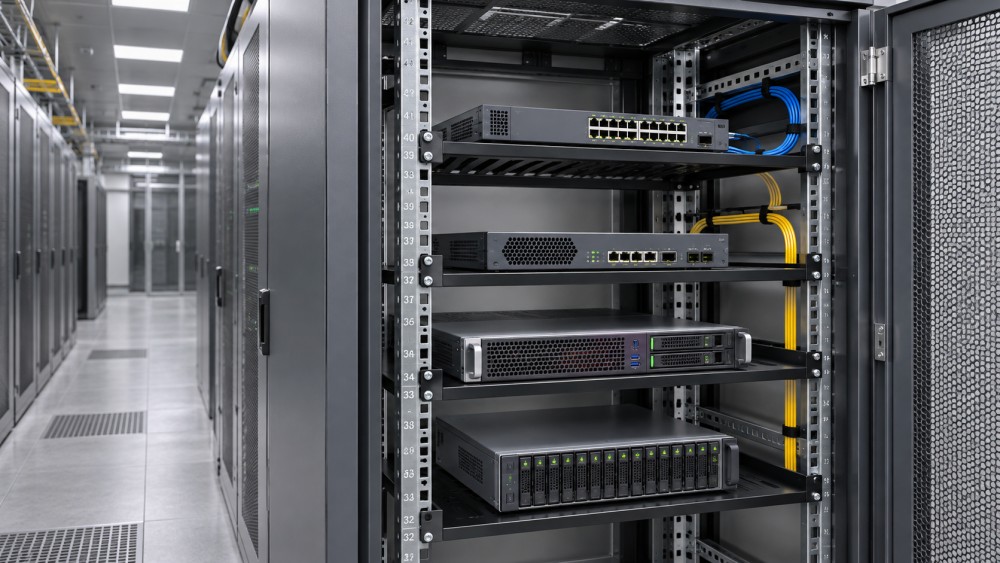
Request a dimensioned drawing showing usable platform width and depth, mounting range, bracket positions and any raised edges. If the shelf occupies space above or below its nominal mounting position, verify that the neighboring equipment will still fit. A nominal rack-unit height alone may not reveal every obstruction.
Choose the mounting method for the load and the job
Server rack shelves are commonly supplied as fixed or sliding designs, with support from two or four rack posts. The right configuration depends on the rack, equipment and maintenance procedure—not simply on which model has the lowest unit price.
A sliding mechanism can make inspection easier, but it also introduces moving components, service clearance and cable-management requirements. The connected cables must accommodate the full intended travel without tension or excessive bending. If operators rarely need to pull the device forward, a fixed shelf with adequate rear access may be the simpler purchase.
Confirm the rack’s mounting-hole type and dimensions, including whether cage nuts, threaded fasteners or other fittings are required. “Fits a 19-inch rack” is not enough to establish compatibility with every cabinet. Ask whether the quotation includes all brackets and hardware for the actual installation, and whether tools or rack-specific adapters are excluded.
Check cooling and access before approving the layout
The shelf is part of the airflow environment. A solid surface can obstruct ventilation openings underneath equipment or interrupt an intended air path; a perforated surface can help in some layouts, but does not by itself guarantee adequate cooling. Compare the device’s intake and exhaust locations with the cabinet’s airflow design and the manufacturer’s clearance instructions.
In dense data center racks, a small obstruction can also complicate cable routing or access to power equipment. Where liquid-cooling components or hoses are nearby, check service clearances and avoid placing a shelf where it interferes with connections, inspection or the site’s leakage-management arrangements. These considerations depend on the specific rack design; they are not a reason to assume that every perforated or short-depth shelf is suitable.
There is also a security question. Equipment resting on a shelf may need a manufacturer-approved restraint against unintended movement. Confirm whether straps or brackets are available and compatible with ventilation, service access and any site-specific transport or seismic requirements. A shelf’s static load rating should not be presented as proof of restraint performance.
Compare delivered and installed cost, not just unit price
A low shelf price can disappear quickly if fasteners, rear supports or compatible rails are sold separately. For a multi-site order, freight, import charges, local taxes and delivery terms can change the comparison. Request prices on the same basis and make clear whether each quotation covers delivery to the site, unloading and any required documentation.
Installation time deserves a separate line of inquiry. Ask whether rail adjustment requires cabinet disassembly, rear access or specialized tools. A shelf that can only be fitted before neighboring equipment is installed may be inexpensive in a new rack but costly during a live retrofit. Similarly, a substitute model with a different mounting range can disrupt an otherwise standardized rollout.
Consider replacement and availability as well. Confirm lead time, whether the quoted configuration is in stock or made to order, and how changes to brackets or materials will be communicated. For a larger deployment, a sample or pilot installation can expose a compatibility problem before the full order ships. Agree in advance on who pays for corrections if the delivered item differs from the approved specification.
This is consistent with the procurement perspective proposed for RackLedger: a component’s cost should be evaluated alongside integration, delivery and operating requirements. A shelf is inexpensive relative to much of the equipment it supports, but a poor fit can consume maintenance time and delay a rack deployment.
What to put in the quotation request
A useful request gives suppliers enough information to confirm the application, while requiring responses that can be compared. Include the rack make and model where known, mounting-hole details, measured rail spacing, available rack units, equipment dimensions and operating weight. Describe how the load contacts the shelf and whether the equipment must be accessed while mounted.
Ask each supplier to return the following with its quotation:
- The rated load, applicable mounting configuration, load-distribution assumptions and supporting test or engineering documentation.
- A dimensioned drawing showing usable platform space, mounting range, occupied rack space and any projections.
- A complete list of included brackets, fasteners and accessories, plus the price and availability of excluded parts.
- For sliding shelves, the permitted load when extended, required clearance, locking method and any cabinet-stability conditions.
- Lead time, delivery terms, warranty conditions, replacement-part availability and any applicable project-specific compliance evidence.
Make acceptance criteria explicit. On delivery, check the model and hardware against the approved quotation; during installation, verify the rail fit, equipment support, door closure, cable clearance and access. Do not load-test a shelf beyond approved procedures simply to prove capacity. Where evidence is incomplete, resolve the discrepancy with the supplier and the responsible engineer before placing equipment into service.
The strongest comparison is not necessarily the one with the highest published load rating. It is the one that demonstrates adequate support in the actual rack, leaves the equipment serviceable and accounts for the full cost of getting the shelf installed and maintained.
Questions about data center smoke detection standards? Contact RackLedger for further insights.
We respect your privacy. Your information is strictly confidential.
Recommended News
 Choosing Server Rack Vibration Dampers for Sensitive IT EquipmentChoose Server Rack Vibration Dampers with confidence. Explore load, frequency, anchoring, and supplier criteria for sensitive IT equipment.Nov 04, 2026
 How rack power density affects prefabricated data center rack capacityDiscover how rack power density affects prefabricated data center rack capacity, and learn to assess power, cooling, redundancy, and layout limits.Nov 04, 2026
 Server Chassis Airflow: Why Hot Spots Form and How to Fix ThemServer Chassis hot spots can develop even in cool data centers. Discover how to trace airflow issues, fix common causes, and verify cooling performance.Nov 04, 2026
 Choosing Server Rack Shelves: Load Capacity, Depth and MountingServer Rack Shelves made simple: compare load capacity, usable depth and mounting options to choose a safe, compatible shelf with confidence.Nov 04, 2026